

CCUS Industry Growth Accelerates with Rising Investments in Clean Energy Technologies
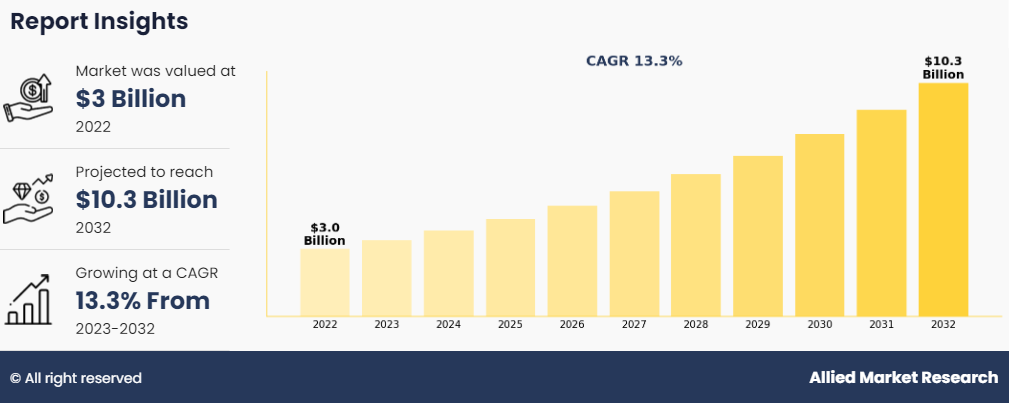
Global CCUS Market to Reach $10.3 Billion by 2032 Amid Rising Carbon Reduction Efforts.
Global CCUS market growth is driven by rising carbon reduction goals, industrial decarbonization, and clean energy investments.”
WILMINGTON, DE, UNITED STATES, May 26, 2026 /EINPresswire.com/ -- — Allied Market Research
According to a new report published by Allied Market Research, the global carbon capture, utilization, and storage (CCUS) market size was valued at $3 billion in 2022 and is projected to reach $10.3 billion by 2032, growing at a CAGR of 13.3% from 2023 to 2032. The growing global focus on reducing carbon emissions, rising industrial decarbonization initiatives, and increasing investments in clean energy technologies are major factors driving the growth of the carbon capture, utilization, and storage market worldwide.
Download PDF Brochure: https://www.alliedmarketresearch.com/request-sample/A12116
Introduction to the Carbon Capture, Utilization, and Storage Market
Carbon capture, utilization, and storage, commonly known as CCUS, is an advanced emissions reduction technology designed to prevent large volumes of carbon dioxide from entering the atmosphere. The process involves capturing carbon dioxide generated by industrial activities and energy production, transporting it to suitable locations, and storing or utilizing it safely for long-term environmental benefits.
The carbon capture, utilization, and storage market has gained significant importance as governments and industries across the globe intensify efforts to combat climate change and achieve net-zero emission targets. CCUS technologies are becoming essential tools for reducing greenhouse gas emissions from hard-to-abate sectors such as oil & gas, power generation, cement, iron & steel, and chemical manufacturing.
Modern CCUS systems not only reduce industrial emissions but also support sustainable industrial development by enabling companies to continue operations while lowering their environmental impact. As industries increasingly focus on decarbonization strategies, the adoption of carbon capture technologies is expected to accelerate significantly during the forecast period.
Understanding the Carbon Capture Process
The carbon capture, utilization, and storage market is built around three key operational stages: capture, transportation, and storage or utilization. Each stage plays a crucial role in reducing carbon dioxide emissions from industrial and energy-related activities.
The first stage involves capturing carbon dioxide emissions directly from industrial facilities or power plants before they are released into the atmosphere. Advanced separation technologies are used to isolate carbon dioxide from industrial gases generated during production processes.
Once captured, the carbon dioxide is compressed and transported to designated storage or utilization sites through pipelines, trucks, or ships. Transportation infrastructure is critical for ensuring the safe and efficient movement of carbon dioxide across industrial networks.
The final stage involves storing the carbon dioxide deep underground in geological formations such as depleted oil reservoirs, saline aquifers, or deep rock formations. In some cases, captured carbon dioxide is utilized for industrial applications such as enhanced oil recovery, chemical manufacturing, and synthetic fuel production.
This integrated process is helping industries significantly reduce their carbon footprints while supporting environmental sustainability goals.
Growing Focus on Carbon Emission Reduction Driving the CCUS Market
One of the primary drivers accelerating the growth of the carbon capture, utilization, and storage market is the increasing global focus on reducing carbon dioxide emissions. Governments, environmental organizations, and industries worldwide are implementing stricter regulations and sustainability initiatives to address climate change concerns.
Industrial sectors such as cement, steel, oil & gas, and power generation are among the largest contributors to global carbon emissions. These industries are increasingly adopting CCUS technologies to comply with emission reduction regulations while maintaining production efficiency.
Many countries have introduced carbon neutrality targets and environmental policies encouraging investments in carbon capture infrastructure. Public and private organizations are also investing heavily in research and development activities to improve the efficiency and affordability of CCUS systems.
As global climate commitments continue strengthening, the carbon capture, utilization, and storage market is expected to witness substantial growth over the next decade.
Enhanced Oil Recovery Supporting Market Expansion
The growing use of carbon dioxide for enhanced oil recovery (CO2-EOR) is another significant factor contributing to the expansion of the carbon capture, utilization, and storage market. Enhanced oil recovery involves injecting captured carbon dioxide into mature oil reservoirs to increase extraction efficiency and improve oil production rates.
The oil & gas industry is one of the leading adopters of CCUS technologies because carbon dioxide injection helps maximize resource recovery while simultaneously reducing industrial emissions.
Captured carbon dioxide can remain permanently stored underground after the enhanced oil recovery process, making CO2-EOR an effective strategy for combining energy production with carbon management.
The increasing demand for efficient oil extraction methods and sustainable energy operations is expected to continue driving investments in carbon capture technologies within the oil & gas sector.
Industrial Decarbonization Creating Strong Market Demand
The transition toward low-carbon industrial operations is significantly boosting the demand for the carbon capture, utilization, and storage market. Heavy industries such as cement manufacturing, iron & steel production, chemicals, and petrochemicals face considerable challenges in reducing emissions due to the energy-intensive nature of their operations.
CCUS technologies provide these industries with practical solutions for lowering carbon emissions without disrupting production processes. Many industrial companies are incorporating carbon capture systems into their sustainability and environmental management strategies.
In addition, businesses are increasingly prioritizing environmental, social, and governance (ESG) goals, encouraging investments in advanced emission reduction technologies.
The growing emphasis on industrial decarbonization is expected to remain one of the strongest growth drivers for the carbon capture, utilization, and storage market throughout the forecast period.
Rising Investments in Carbon Capture Projects
The carbon capture, utilization, and storage market is witnessing substantial investments from both public and private sectors. Governments are offering financial incentives, tax benefits, and funding programs to encourage the development of carbon capture infrastructure and clean energy projects.
Leading energy companies and industrial organizations are actively investing in pilot projects, partnerships, and commercial-scale CCUS facilities to strengthen their sustainability initiatives.
For example, several global companies are developing large-scale carbon capture projects designed to capture millions of tons of carbon dioxide annually. These projects demonstrate the growing commercial viability and environmental importance of CCUS technologies.
Strategic collaborations between energy companies, technology providers, and government agencies are also accelerating the deployment of advanced carbon capture solutions across multiple industries.
Buy This Report (210 Pages PDF with Insights, Charts, Tables, and Figures): https://www.alliedmarketresearch.com/carbon-capture-and-utilization-market/purchase-options
Technological Advancements Enhancing CCUS Efficiency
Continuous technological innovation is playing a vital role in the expansion of the carbon capture, utilization, and storage market. Researchers and technology companies are developing advanced capture technologies capable of improving efficiency while reducing operational costs.
New solvent-based capture systems, membrane technologies, cryogenic separation methods, and adsorption technologies are helping industries optimize carbon capture processes and improve performance.
Digital monitoring systems and artificial intelligence are also enhancing operational efficiency by enabling real-time performance analysis and predictive maintenance for CCUS infrastructure.
In addition, ongoing advancements in transportation and storage technologies are improving the safety and reliability of carbon dioxide management systems.
These technological developments are expected to make carbon capture solutions more commercially attractive and accessible for industries worldwide.
High Costs Remain a Major Challenge
Despite strong market growth potential, the carbon capture, utilization, and storage market faces challenges related to high implementation costs. Establishing CCUS infrastructure requires substantial capital investments for capture equipment, transportation systems, compression facilities, and storage sites.
Operational expenses associated with energy consumption, maintenance, and monitoring can also increase project costs significantly.
Many industries, particularly in developing regions, face financial constraints that may limit large-scale adoption of carbon capture technologies.
However, continuous technological advancements, government incentives, and economies of scale are expected to gradually reduce costs and improve the economic feasibility of CCUS projects over time.
Capture Segment Dominates the Market
Based on service, the capture segment accounted for the largest share of the carbon capture, utilization, and storage market in 2022. The increasing adoption of carbon capture systems across industries such as oil & gas, cement, chemicals, and power generation is driving the growth of this segment.
Industrial facilities are prioritizing emission reduction strategies that enable them to capture carbon dioxide directly from production processes before release into the atmosphere.
The growing global focus on sustainability and carbon neutrality goals is expected to continue supporting the dominance of the capture segment during the forecast period.
Post-Combustion Technology Leading the Market
Based on technology, the post-combustion capture segment held the largest share of the carbon capture, utilization, and storage market in 2022.
Post-combustion technologies are widely used because they can be integrated into existing industrial facilities and power plants without requiring major operational modifications.
These systems capture carbon dioxide from flue gases generated after fuel combustion, making them suitable for coal-fired and natural gas power plants.
The increasing adoption of post-combustion technologies in the power generation sector is expected to contribute significantly to market growth over the coming years.
Oil & Gas Sector Dominates Application Segment
The oil & gas segment emerged as the leading application area within the carbon capture, utilization, and storage market in 2022. The sector extensively uses carbon dioxide for enhanced oil recovery operations while simultaneously reducing industrial emissions.
Oil & gas companies are actively investing in carbon management technologies to improve environmental performance and align with sustainability objectives.
In addition, increasing global energy demand and environmental regulations are encouraging oil producers to adopt advanced CCUS solutions capable of balancing production efficiency with emission reduction goals.
North America Leading the Global CCUS Market
Region-wise, North America dominated the carbon capture, utilization, and storage market in 2022 due to strong industrial infrastructure, favorable government policies, and substantial investments in clean energy technologies.
The region benefits from extensive oil & gas operations, advanced research capabilities, and established carbon transportation infrastructure.
Government initiatives aimed at reducing greenhouse gas emissions and promoting carbon management technologies are also contributing to regional market growth.
In addition, several large-scale CCUS projects are currently operational or under development across North America, strengthening the region’s leadership position in the global market.
Asia-Pacific and Europe Emerging as High-Growth Regions
Asia-Pacific and Europe are expected to witness significant growth in the carbon capture, utilization, and storage market during the forecast period.
Rapid industrialization, increasing energy demand, and rising environmental concerns are encouraging countries in these regions to adopt advanced carbon reduction technologies.
Governments across Europe are implementing aggressive climate policies and investing heavily in sustainable energy infrastructure. Similarly, Asia-Pacific countries are increasingly focusing on industrial decarbonization and emission reduction initiatives.
The growing number of upcoming CCUS projects in these regions is expected to create lucrative growth opportunities for market participants.
Competitive Landscape of the CCUS Market
The global carbon capture, utilization, and storage market is highly competitive, with major companies focusing on technological innovation, strategic collaborations, and large-scale project development to strengthen their market presence.
Key players operating in the market include Shell, Chevron, Exxon Mobil Corporation, Honeywell International, Halliburton, Mitsubishi Heavy Industries, Linde, Siemens, General Electric, and Equinor.
These companies are investing in advanced carbon capture technologies, transportation infrastructure, and long-term storage solutions to expand their global presence and support sustainable industrial operations.
Get a Customized Research Report: https://www.alliedmarketresearch.com/request-for-customization/A12116
Future Outlook of the Carbon Capture, Utilization, and Storage Market
The future of the carbon capture, utilization, and storage market appears highly promising as industries and governments intensify efforts to achieve net-zero emission targets and combat climate change.
Technological advancements, increasing investments, supportive government policies, and rising industrial decarbonization initiatives are expected to accelerate market growth significantly over the next decade.
The integration of CCUS technologies into industrial operations, energy production systems, and clean fuel development will continue supporting global sustainability objectives.
As environmental regulations become stricter and demand for low-carbon technologies rises, the carbon capture, utilization, and storage market is expected to play a critical role in shaping the future of global climate management and sustainable industrial development.
Trending Reports in Energy and Power Industry:
Carbon Capture and Storage (CCS) in Power Generation Market
https://www.alliedmarketresearch.com/carbon-capture-and-storage-in-power-generation-market-A212152
Carbon Capture, Utilization, and Storage (CCUS) Market
https://www.alliedmarketresearch.com/carbon-capture-and-utilization-market-A12116
Carbon Capture Technology Market
https://www.alliedmarketresearch.com/carbon-capture-technology-market-A191506
Carbon Capture Market
https://www.alliedmarketresearch.com/carbon-capture-market-A175658
Renewable Energy Market
https://www.alliedmarketresearch.com/renewable-energy-market
Bioenergy With CCS Market
https://www.alliedmarketresearch.com/bioenergy-with-ccs-market-A325513
Carbon Credit Trading Platform Market
https://www.alliedmarketresearch.com/carbon-credit-trading-platform-market-A145082
Carbon Credits Market
https://www.alliedmarketresearch.com/carbon-credits-market-A107126
Decarbonization Market
https://www.alliedmarketresearch.com/decarbonization-market-A325581
Carbon Capture and Sequestration Market
https://www.alliedmarketresearch.com/carbon-capture-and-sequestration-market-A129862
Low Carbon Building Market
https://www.alliedmarketresearch.com/low-carbon-building-market-A325511
Renewable Energy Certificates Market
https://www.alliedmarketresearch.com/renewable-energy-certificates-market
Waste to Energy Market
https://www.alliedmarketresearch.com/waste-to-energy-market
Energy Transition Market
https://www.alliedmarketresearch.com/energy-transition-market-A31819
About Us
Allied Market Research (AMR) is a full-service market research and business-consulting wing of Allied Analytics LLP based in Portland, Oregon. Allied Market Research provides global enterprises as well as medium and small businesses with unmatched quality of "Market Research Reports" and "Business Intelligence Solutions." AMR has a targeted view to provide business insights and consulting to assist its clients to make strategic business decisions and achieve sustainable growth in their respective market domain.
Pawan Kumar, the CEO of Allied Market Research, is leading the organization toward providing high-quality data and insights. We are in professional corporate relations with various companies and this helps us in digging out market data that helps us generate accurate research data tables and confirms utmost accuracy in our market forecasting. Each and every data presented in the reports published by us is extracted through primary interviews with top officials from leading companies of domain concerned. Our secondary data procurement methodology includes deep online and offline research and discussion with knowledgeable professionals and analysts in the industry.
David Correa
Allied Market Research
+ + + + + + + + + + + + +1 800-792-5285
email us here
Visit us on social media:
LinkedIn
Facebook
YouTube
X
Legal Disclaimer:
EIN Presswire provides this news content "as is" without warranty of any kind. We do not accept any responsibility or liability for the accuracy, content, images, videos, licenses, completeness, legality, or reliability of the information contained in this article. If you have any complaints or copyright issues related to this article, kindly contact the author above.
