

Organic Pigments Market to Reach $8.21 Billion by 2035 as Digital Printing and EV Coatings Reshape Color Chemistry
Organic Pigments Market
North America holds a 14.8% share, supported by investment in high-performance pigments for aerospace and specialty coatings.
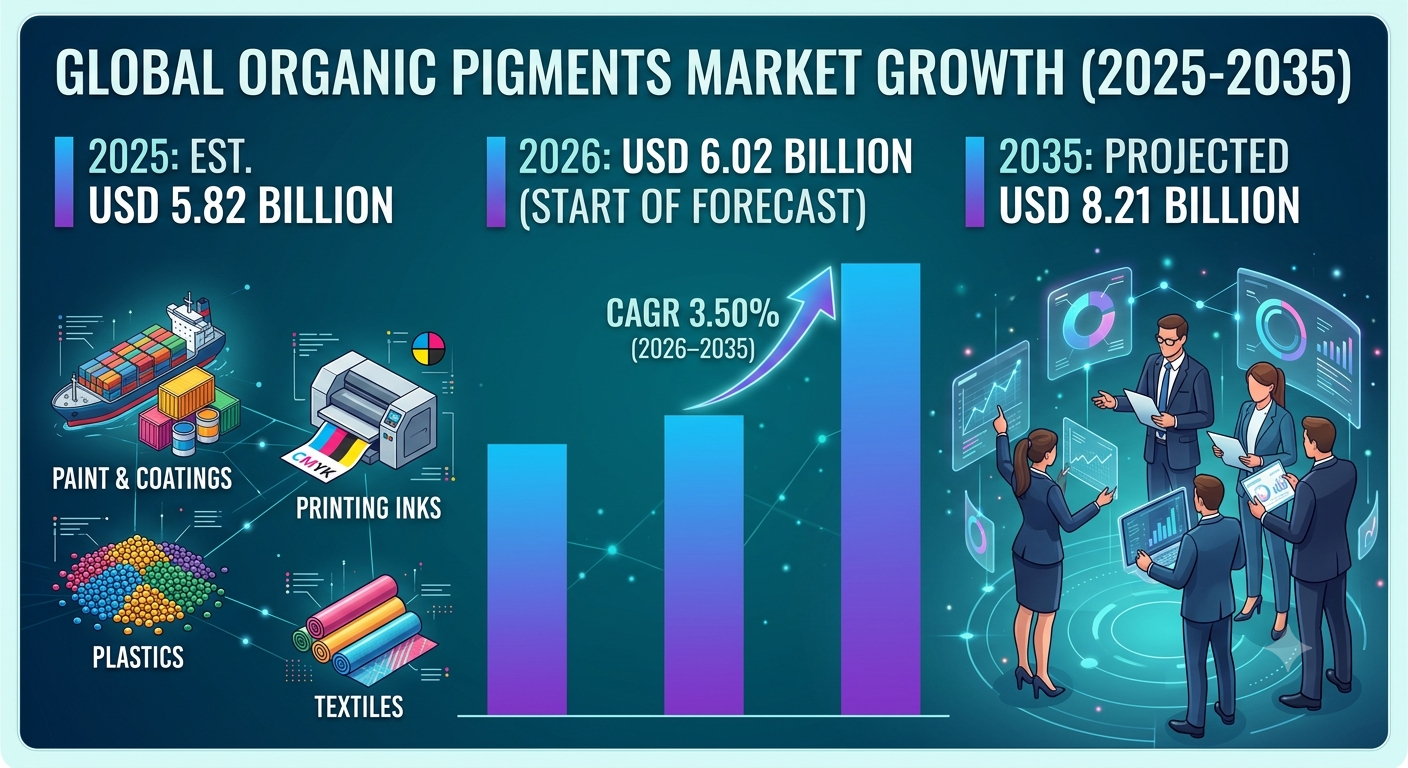
NJ, UNITED STATES, July 14, 2026 /EINPresswire.com/ -- According to a comprehensive report by Market Research Future (MRFR), the global organic pigments market reached an estimated USD 5.82 billion in 2025 and is projected to grow from USD 6.02 billion in 2026 to USD 8.21 billion by 2035, registering a compound annual growth rate of 3.50%. This growth is being driven by three converging forces: the explosive expansion of digital textile and packaging printing, tightening European regulations on microplastics and aromatic amines that are compelling reformulation toward cleaner chemistries, and the electrification of transport that is creating new functional color requirements for batteries, sensors, and lightweight bodies.The Digital Printing Revolution: Particle Size as Competitive Moat
The most transformative demand driver for the organic pigments market is the migration from analog to digital printing across textiles, packaging, and industrial decoration. Digital textile printing accounted for just 8% of worldwide textile ink volume in 2023, but it is expected to reach 30% by 2035. This shift is not merely a change in equipment; it is a fundamental rewiring of pigment specifications. Digital inkjet presses demand ultrafine-particle-size printing ink pigments with sub-200-nm dispersion and D50 near 80–100 nm—specifications that legacy batch-reactor processes struggle to achieve consistently.
Coarser distributions clog printheads and cause nozzle dropout, making particle-size control a non-negotiable quality parameter. Early movers that sell inkjet-grade textile dye pigments to digital press OEMs can capture premium margins exceeding 35% above conventional grades. Toyoink Group signed a joint-development agreement with a Japanese digital press OEM in May 2023 to co-develop next-generation inkjet textile dye pigments with sub-150-nm particle sizes—a partnership that exemplifies how pigment suppliers are evolving from commodity vendors to technology partners.
The e-commerce packaging boom amplifies this trend. Global e-commerce sales surpassed USD 6.3 trillion in 2024, and every shipment generates 1.8–2.2 square meters of printed substrate on average. Brand differentiation on shelf and screen depends on color consistency, pushing converters toward high-consistency printing ink pigments with tighter delta-E tolerances. MRFR estimates that flexible-packaging inks alone will absorb an additional 42,000 tonnes of colorant chemicals annually by 2030. This is not incremental growth; it is a structural shift in how pigments are specified, purchased, and valued.
Download Report Sample Copy with TOC: https://www.marketresearchfuture.com/sample_request/1687
Regulatory Tightening: Compliance as Innovation Catalyst
The European regulatory environment is reshaping the organic pigments market from the supply side. The European Chemicals Agency's proposed restriction on intentionally added microplastics, published in 2023 and effective from 2025, affects pigment dispersions used in cosmetic pigment materials and rinse-off products. Concurrently, the EU's revised REACH restrictions on certain aromatic amine intermediates are compelling formulators to reformulate with compliant synthetic organic colorants, accelerating the adoption of cleaner pigment chemistries.
The revised EU Classification, Labelling and Packaging (CLP) regulation, effective 2026, adds an estimated EUR 15,000–25,000 per substance dossier update. Smaller specialty color pigments manufacturers with 50+ SKUs face disproportionate compliance burdens, potentially exiting niche segments and reducing overall innovation velocity. Yet this regulatory pressure is also creating competitive moats for producers with sophisticated analytical capabilities and robust safety documentation. The convergence of ECHA, U.S. EPA, and emerging Asian regulatory frameworks is gradually harmonizing safety evaluation methodologies, reducing the fragmentation that has historically complicated global trade.
The EU's Chemicals Strategy for Sustainability and the Corporate Sustainability Reporting Directive (CSRD) will require European coatings companies to disclose Scope 3 emissions across their pigment supply chains by 2027. Producers of synthetic organic colorants who invest in lifecycle assessments and closed-loop solvent recovery will gain preferential supplier status, while those reliant on carbon-intensive batch processes risk exclusion from key OEM approved-vendor lists. This is transforming environmental compliance from a cost center into a competitive differentiator.
The EV and Functional Coatings Frontier
The electrification of transport is creating an entirely new category of demand for the organic pigments market. The global EV fleet is expected to exceed 525 million vehicles by 2030, per IEA projections. Each vehicle requires 2.5–3.0 kg of pigmented coatings, but EV OEMs demand far more than aesthetic color. High-performance pigments with near-infrared reflective properties reduce cabin heat load, cutting air-conditioning energy consumption and extending range. Radar-transparent formulations for ADAS sensor zones ensure that autonomous driving systems function correctly through painted surfaces. These functional requirements create a differentiated product tier that justifies 20–25% price premiums over standard automotive grades.
OEMs now specify 10-year Florida-equivalent weathering resistance for exterior basecoats, a standard that commodity monoazo grades cannot meet. Quinacridone and diketopyrrolopyrrole (DPP) grades deliver the required light- and chemical-fastness, creating a premium segment within the organic pigments market. The shift toward electric vehicles amplifies demand because EV brand identity often relies on distinctive, saturated colorant chemicals that only quinacridone and DPP chemistries can deliver at production scale. Europe's Euro 7 framework further incentivizes low-VOC coatings that rely on finely milled high-performance pigments.
Purchase Now: https://www.marketresearchfuture.com/checkout?currency=one_user-USD&report_id=1687
Technology Transformation: From Batch to Continuous Flow
A significant technology shift is reshaping how printing ink pigments and specialty color pigments are manufactured. Legacy batch-reactor processes—plagued by 12–15% yield losses—are giving way to continuous-flow synthesis platforms that cut waste by up to 40% and slash energy consumption per kilogram of finished pigment. Major producers have collectively committed over USD 900 million in capacity modernization between 2023 and 2027.
Continuous-flow microreactor technology enables pigment producers to operate modular plants closer to end-use markets, cutting logistics costs for plastic coloring materials and printing ink pigments by 15–20%. MRFR anticipates that at least eight new modular pigment facilities will begin operations in India, Southeast Asia, and the Middle East between 2027 and 2032. These plants reduce batch-to-batch delta-E variance to below 0.3, compared with 0.8–1.2 in conventional batch processes, enabling the tighter color tolerances that digital printing and automotive OEMs demand.
AI-integrated color management ecosystems are adding a digital layer to the physical pigment business. By 2030, MRFR expects over 40% of major coatings manufacturers to deploy AI-driven color-matching platforms that link spectrophotometric data directly to pigment ordering systems. This integration reduces waste of colorant chemicals by an estimated 25% per batch and compresses product development timelines for specialty color pigments from weeks to hours. DIC Corporation and Clariant are leading investment in these AI-driven color-matching ecosystems, transforming pigment suppliers from commodity vendors into solution partners with recurring SaaS revenue.
Product and Segment Dynamics
Azo pigments held approximately 48.2% of the organic pigments market share in 2025, owing to cost-efficient production and broad compatibility with paint color additives and printing ink pigments. Monoazo yellows and diarylide oranges together account for over 60% of the azo sub-category, with demand anchored in packaging flexo and gravure inks across Asia-Pacific. Azo pigments dominate because they deliver the broadest chromatic range at the lowest per-kilogram cost, making them the default choice for commodity applications.
Quinacridone grades are the fastest-growing pigment type, forecast to register a 4.75% CAGR through 2035. Valued for exceptional lightfastness and transparency, quinacridones are the pigment of choice for automotive OEMs specifying weather-resistant metallic and pearlescent basecoats. The shift toward distinctive EV brand colors is accelerating demand for these premium specialty color pigments.
Phthalocyanine pigments—the blues and greens that dominate industrial coatings—are projected to reach a valuation of USD 3,500 million by 2035, the highest of any segment. Their durability and cost-efficiency sustain demand across marine, architectural, and powder coatings.
By source, synthetic routes accounted for 93.0% of the market in 2025, reflecting mature supply chains and decades of process optimization in diazo coupling, pigmentation, and surface treatment. Natural and bio-based pigment alternatives are projected to expand at a 4.62% CAGR, the fastest-growing source segment, as EU and North American microplastics regulations tighten and consumer demand for clean-label cosmetic pigment materials converges.
By end-user industry, printing inks consumed 46.5% of volume in 2025, underscoring the link between e-commerce packaging and printing ink pigments demand. Paints and coatings represented USD 1.69 billion, anchored by construction and automotive refinish. Textile is the fastest-growing end-user vertical at a 4.70% CAGR, propelled by digital printing presses and fast-fashion output requiring durable textile dye pigments. Plastics and polymer applications are advancing at a 3.55% CAGR, driven by colored engineering plastics and packaging.
Report Summary: https://www.marketresearchfuture.com/reports/organic-pigments-market-1687
Regional Dynamics: Asia-Pacific Dominates, Europe Leads in Value-Added
Asia-Pacific commands roughly 53.1% of global volume, the largest regional share, and simultaneously posts the fastest growth at a projected 5.28% CAGR through 2035. China's Zhejiang and Jiangsu provinces host over 60% of worldwide azo pigment capacity, making the country the dominant producer and consumer of colorant chemicals. India's 5.45% CAGR is driven by construction, textile exports, and government manufacturing incentives. Sudarshan Chemical and Meghmani Organics are scaling continuous-flow reactors in Gujarat to serve export markets. Digital textile printing in Bangladesh and Vietnam is opening new channels for ultrafine printing ink pigments.
Japan contributes USD 0.31 billion through automotive and electronics coatings, while South Korea's display films and packaging inks sustain a 3.80% CAGR. The ASEAN bloc, valued at USD 0.29 billion, benefits from textile exports and construction booms across Indonesia, Thailand, and Vietnam.
Europe holds the second-largest share at 22.4%, driven by stringent sustainability mandates that favor high-performance pigments and bio-derived alternatives. Germany anchors regional demand at USD 0.38 billion through its automotive OEM and industrial coatings supply chain. The UK's 2.95% CAGR reflects packaging inks and decorative paints, while France's USD 0.19 billion market is driven by cosmetic pigment materials for prestige beauty brands.
Europe's regulatory environment shapes the organic pigments market more than any other region—ECHA's microplastics restriction and the EU Green Deal's Chemicals Strategy for Sustainability push formulators toward bio-based specialty color pigments with fully disclosed supply chains.
North America accounts for 14.8% of global revenue, supported by investment in high-performance pigments for aerospace and specialty coatings. The United States drives regional growth at a 3.48% CAGR through flexible packaging and aerospace coatings. Canada's USD 0.16 billion market benefits from construction coatings and bio-based mandates, while Mexico's 3.65% CAGR reflects nearshoring of automotive paint operations to Guanajuato and Puebla.
South America holds 5.6% of global share, with Brazil dominating at USD 0.22 billion through architectural coatings and agri-packaging. The Middle East & Africa, at 4.1%, is the smallest but fastest-emerging region. Saudi Arabia's Vision 2030 mega-projects—including NEOM and the Red Sea Development—are generating unprecedented demand for durable paint color additives and plastic coloring materials.
Emerging Opportunities: Bio-Based, Modular Manufacturing, and Data Monetization
Several transformative trends are poised to reshape the organic pigments market. Bio-based pigment development is the most significant long-term opportunity. The global green chemicals market reached USD 120 billion in 2024, creating white space for organically produced colorant chemicals. While current-generation bio-based grades achieve 3–5 years of exterior durability—sufficient for decorative use but below the 10-year threshold demanded by automotive or industrial coatings—fermentation-derived indigos and algae-sourced greens are gaining traction as ECHA restrictions and consumer demand for clean-label cosmetic pigment materials converge.
Decentralized and modular manufacturing is reducing logistics costs and improving responsiveness. Continuous-flow microreactor technology enables pigment producers to operate modular plants closer to end-use markets, cutting logistics costs by 15–20%. Local grinding and dispersion capacity for paint color additives in Nigeria, Kenya, and Egypt could capture a USD 180–220 million incremental addressable opportunity as Africa's construction spending reaches USD 200 billion annually by 2030.
Data-enabled color-matching services are transforming the business model. Cloud-based formulation tools enable first-time-right color matching on any substrate, requiring 60% fewer trial batches. Integrated digital color libraries with tangible specialty color pigments from pigment suppliers shift suppliers from commodity vendors to solution partners, yielding recurring SaaS revenue. By 2030, AI-driven color-matching platforms will link spectrophotometric data directly to pigment ordering systems, compressing product development timelines from weeks to hours.
Competitive Landscape
The organic pigments market exhibits medium concentration, with the top five producers accounting for an estimated 38–44% of global revenue and a Herfindahl-Hirschman Index in the 800–1,100 range. Mid-sized Asian producers compete effectively with European incumbents on cost, while differentiated players command premiums through color-matching platforms and technical service.
BASF SE leads with an estimated 8–11% revenue share, distinguished by its integrated chemistry platform and strong automotive OEM reach through its Paliotol, Paliogen, and Irgalite ranges. Clariant AG captures 7–10% through sustainability leadership and bio-based pigment R&D, with its Permanent, Graphtol, and Novoperm lines. DIC Corporation holds 6–9% through vertical integration with Sun Chemical for ink pigments, while Sun Chemical itself accounts for 5–8% with global ink supply chain dominance and digital color management capabilities.
Heubach Group consolidated legacy Clariant and BASF pigment lines to achieve 4–7% share, while Sudarshan Chemical leverages low-cost Indian manufacturing at 3–5%. Recent strategic moves include DIC Corporation's acquisition of a specialty pigment plant in Gujarat, India, in June 2024, expanding production of azo-based printing ink pigments for South Asian and Middle Eastern markets. Sudarshan Chemical inaugurated a 12,000-tonne-per-annum specialty pigment facility in Roha, Maharashtra, in November 2023, doubling export capacity for synthetic organic colorants to European and North American coatings formulators.
Related Report
Industrial Lubricants Market https://www.marketresearchfuture.com/reports/industrial-lubricants-market-2695
Asia Pacific Silica Sand Market https://www.marketresearchfuture.com/reports/asia-pacific-silica-sand-market-12686
Polymeric Adsorbents Market https://www.marketresearchfuture.com/reports/polymeric-adsorbents-market-4333
Market Research Future
Market Research Future
+1 855-661-4441
email us here
Legal Disclaimer:
EIN Presswire provides this news content "as is" without warranty of any kind. We do not accept any responsibility or liability for the accuracy, content, images, videos, licenses, completeness, legality, or reliability of the information contained in this article. If you have any complaints or copyright issues related to this article, kindly contact the author above.
