

Energy and technology leaders map the path from AI ambition to industrial-scale deployment on Day 3 of ADIPEC 2026

ADIPEC 2026 Strategic Conference
ADIPEC 2026 Strategic Conference

ADIPEC 2026 AI Zone
• Energy and technology leaders discuss how AI is moving from experimentation to enterprise-scale deployment
• Speakers highlight the importance of data governance, cybersecurity, infrastructure and investment in enabling AI adoption
• Discussions across ADIPEC examine how digital technologies can strengthen productivity, resilience and long-term energy security
Artificial intelligence (AI), digital infrastructure and energy resilience took centre stage on the third day of ADIPEC 2026, as leaders from across the energy, technology and investment sectors examined how AI can be deployed at scale to improve productivity, strengthen operational performance and support more secure energy systems.
Discussions throughout the day reflected a broader industry shift from experimentation to implementation. While companies are increasingly confident in AI's capabilities, speakers emphasised that realising its full value will depend on the data, infrastructure, governance frameworks, and investment to embed the technology across complex industrial operations.
Within the Strategic Conference, the AI, Digital & Technology Innovation programme examined what it takes to build an AI-ready energy system. Speaking in the session titled ‘Beyond digital: how AI is reshaping industries, economies and society’, Helmut von Struve, CEO, Siemens UAE & Middle East, said: "The greatest value from an AI perspective is where industries, and also the essential services we depend on, can be improved. It is really about how we can make essential operations more productive and reliable, and how we can make them more resource-efficient."
Discussions throughout the day also highlighted the importance of collaboration between the energy and technology sectors. In the session ‘Beyond collaboration: redefining energy partnerships for cross-sector collaboration’, John Gilley, CEO, Kent, and Dr Ahmed Mohamed Alebri, CEO, ADNOC Onshore, explored how transparency, digital technologies and data-sharing are enabling deeper industrial partnerships.
Discussing the growing convergence between digital infrastructure and energy systems, John Gilley, CEO, Kent, said: "We are seeing that it is not just about energy; it is about connecting the world's appetite for data with the world's appetite for energy. Each country wants to have control of its own data and energy."
In the session titled “Digital transformation: building an AI-ready energy system”, Rakesh Jaggi, President Digital, SLB, Som Dutta, Group VP – AI and Data Science, DP World, and Ashish Koshy, CEO, Inception42, discussed the data foundations, digital infrastructure and operating models that companies need before AI can be embedded across operations at scale. They agreed that the greatest value will come from treating AI as a core capability, not a series of isolated pilots.
Addressing concerns that AI could replace rather than support workers, Ashish Koshy, CEO, Inception42, argued that the greatest value would come from combining human expertise with machine intelligence, saying: "It has to be not AI versus humans, but humans augmented by AI."
Data and security came to the fore in ‘Energy data sovereignty: ownership, access and AI in critical infrastructure’, where technology CEOs discussed who should control the data flowing through energy systems and how it could be shared without exposing critical assets. As AI adoption accelerates, speakers argued that confidence in the technology will depend not only on capability, but on strong governance, cyber resilience and trust.
Dennis Jol, CEO, AIQ, stressed that trust would be fundamental to wider adoption, saying: "Collaboration moves at the speed of trust. If we look at the UAE ecosystem, it is a five-layer cake: energy, data, infrastructure, sovereign cloud and the models we have access to, which maintain security. We sit on top of that. Ultimately, data has to belong to the customer, and customers have to trust us. Cybersecurity rules need to be enhanced. Sovereignty does not need to be national; it just needs to exist within your own framework."
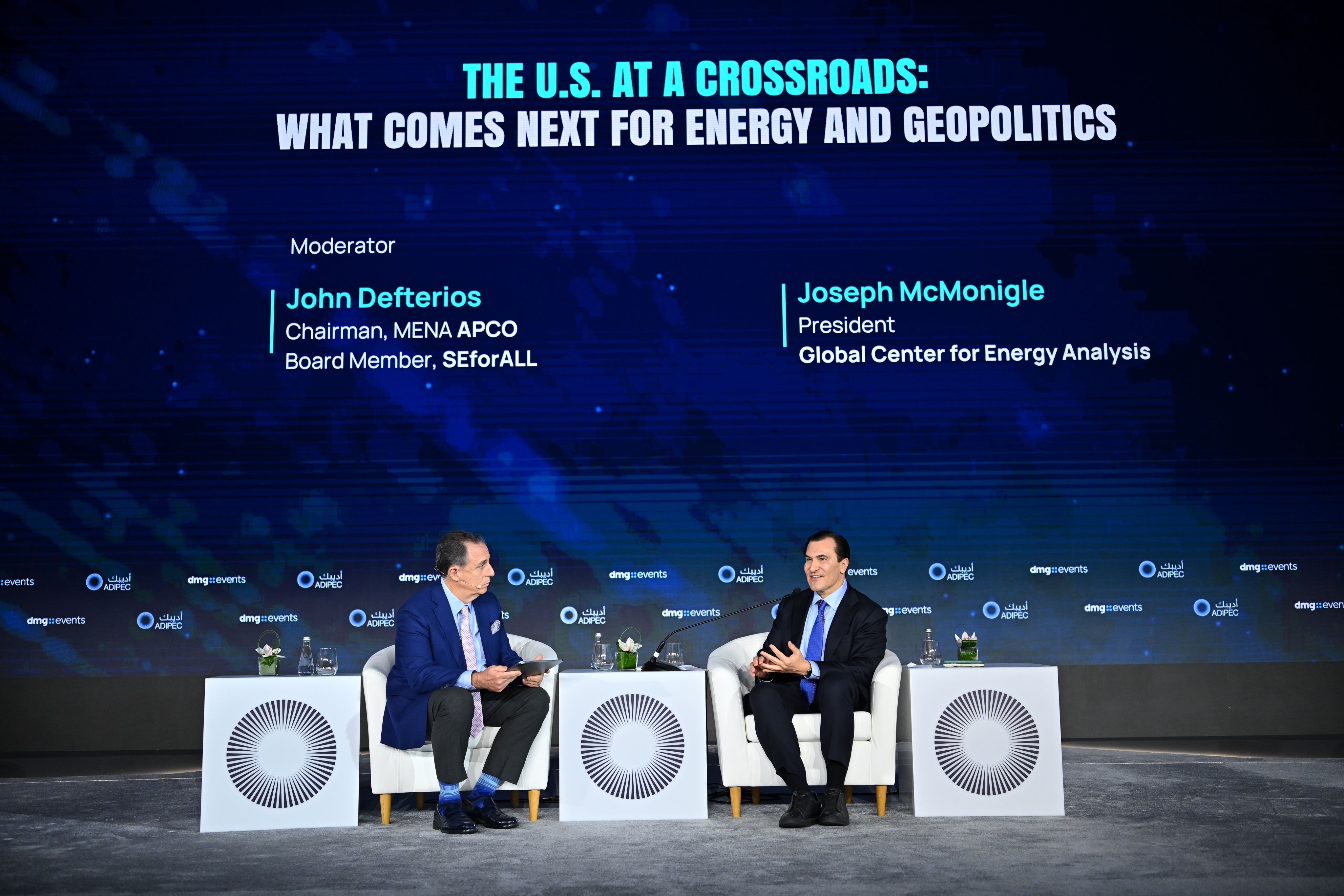
Taking place at a timely moment in the US election cycle, the session titled ‘The US at a crossroads: what comes next for energy and geopolitics’, shared lessons from the rapid expansion of AI infrastructure in the US, which has been facing public pushback.
Joseph McMonigle, President, Global Center for Energy Analysis, explained why bringing communities along on the journey is critical, saying: "I do not think it is going to be possible to avoid moving forward with AI and digital computing, but the industry needs to be much more effective and change its strategy. It needs to pay more attention to the local level. There needs to be some kind of inclusion.”
The security of physical infrastructure was the focus of the session ‘When infrastructure becomes the frontline: supply diversity, storage and resilience’. Discussing the challenge of financing and delivering large-scale energy infrastructure, Tarek El Molla, Founder & Principal Consultant, Luminant Energy Consultancy, and former Minister of Petroleum & Mineral Resources Egypt, said: "Unless governments are more tolerant and open, and offer more incentives for the use of infrastructure, helping secure buy-in from the private sector and multinationals, these projects will not succeed in attracting investment. This is not investment that is easily raised. Therefore, I think that in the coming years, policies will become more relaxed, inviting more private-sector capital."
Offering an investor and project-delivery perspective, fellow speaker Ambassador Martina Strong, Region President, Central Europe and the Middle East, Bechtel, said: "Markets are already looking at the proposition of investing in large, complex infrastructure very differently from how they did, certainly in this part of the world."
The expanded AI Zone, co-hosted by AIQ, provided a practical demonstration of how AI is moving from experimentation into operational deployment across the energy sector. Exhibitors showcased technologies spanning reservoir modelling, autonomous operations, grid management and robotics, highlighting how intelligent systems are being embedded across energy and industrial assets to improve productivity, reliability and decision-making.
Several companies used ADIPEC as a platform to unveil new technologies. Stone Ridge Technology introduced what it describes as the first AI-native pre- and post-processing and workflow orchestration layer built around its GPU-based ECHELON reservoir simulation software, designed to accelerate subsurface analysis and reservoir management. Honeywell showcased AI-driven autonomous upstream operations through its Honeywell Forge Upstream platform, demonstrating how operators can use advanced analytics and automation to optimise asset performance and operational efficiency.
Robotics provided some of the Zone's most visible demonstrations. EY, in partnership with Gecko Robotics, showcased robots capable of climbing, crawling, swimming and flying to inspect critical infrastructure such as pipelines and power plants. Combining high-fidelity asset data with AI-powered analytics, the technology helps predict equipment failures, extend asset life and support investment planning. Meanwhile, Sinaha demonstrated the Autonomous Mobile Robots already deployed in its intelligent warehouses, coordinated through its proprietary Robotics Management System, with manufacturing of the robots set to begin at the company's UAE facility from the first quarter of 2027.
The neighbouring Digitalisation Zone featured digital twins, edge computing platforms, industrial software and cybersecurity solutions designed to support increasingly connected energy systems and increasingly autonomous energy systems. Together, the two zones illustrated a key message emerging from Day 3 discussions: AI's value lies not in isolated use cases, but in its ability to transform operations at scale across the energy value chain.
-ENDS-
ABOUT ADIPEC
Held under the patronage of H.H. Sheikh Mohamed bin Zayed Al Nahyan, President of the United Arab Emirates, in his capacity as Ruler of Abu Dhabi, and hosted by ADNOC, ADIPEC 2026 takes place in Abu Dhabi from 2–5 November.
ADIPEC is where the global energy ecosystem comes together to secure today’s energy, build tomorrow’s capacity and strengthen the systems that power global growth. Bringing together governments, industry, investors and technology leaders, ADIPEC provides a global platform to strengthen supply, mobilise capital, advance technology and build the partnerships needed to support long-term growth.
The event will welcome 239,000 attendees, 2,260+ exhibitors and 1,800+ speakers across its conferences and exhibition.
For more information, visit https://www.adipec.com/ or contact media@adipec.com
For press registration, visit: https://www.adipec.com/press-media/press-registration/
Thomas Hagan
Panterra Global
+44 7570285977
Legal Disclaimer:
EIN Presswire provides this news content "as is" without warranty of any kind. We do not accept any responsibility or liability for the accuracy, content, images, videos, licenses, completeness, legality, or reliability of the information contained in this article. If you have any complaints or copyright issues related to this article, kindly contact the author above.
